


My Four Takeaways from Trump’s Speech
Trump’s speech on Wednesday, April 1, was both unsurprising and revealing. After a month without formally addressing the nation, he offered little that was new beyond what he had already said on Truth Social.
That may itself have been the point. Rather than prepare the country for a broader war or lay out a larger strategic doctrine, he seemed intent on signaling continuity: this remains, in his telling, a limited war with limited aims, even as the Strait of Hormuz has emerged as a more serious flashpoint.
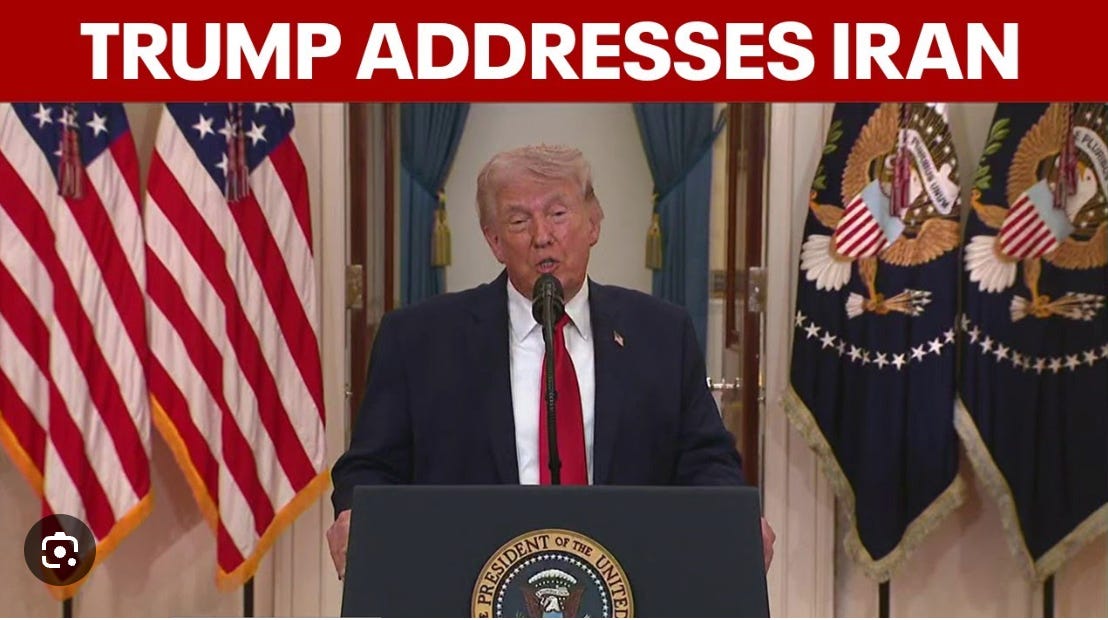
Here are my four main takeaways.
1. No, there has been no regime change and the regime has not become “reasonable”
Trump’s language about regime change and “reasonable people” inside Iranian leadership is not an accurate description of the current power structure of the Islamic Republic. Iran has not suddenly become moderate because some leaders have been killed. The core regime is still there.
I also doubt that Trump has been fooled by Tehran’s familiar effort to present supposedly “reasonable” interlocutors who do not actually control the real centers of power. Trump said regime change was not the goal, but he also claimed that a “less radical and much more reasonable” new group had emerged.
What is missing from that formulation is the central point: the current leaders do not merely share the same ideology as their predecessors. They are the regime. We know who they are: Vahidi (IRGC head), Zolghadr (Supreme National Security Council head), Judiciary Chief Ejei, and the Supreme Leader’s veteran advisers Velayati and Kharrazi. These are hardened, longstanding senior members of the same national security state.
That is why Trump’s claims to have brought about regime change in Iran are so plainly false. He knows they are false. The claim makes him look either foolish, as though he has once again been misled by the marginal office of the Iranian president, who wields no real power over the strategic heights of the system, or deliberately disrespectful of both the Iranian people, who know there has been no regime change, and the American people, who deserve more truthful talk on a matter of this importance.
There is another sign of continuity as well. People I am speaking to inside Iran say that, although many people are hunkering down and much business activity has been disrupted, basic state functions are still operating: water, electricity, schools, health care, and other core services continue to be provided through the bureaucracy. That too suggests that the regime remains intact and capable of controlling the population.
2. “Stone Age” is ugly and counterproductive
Trump said that if the regime did not accept the deal he had proposed in Oman, the United States would hit Iran “extremely hard” and “bring them back to the Stone Ages.”
Yes, this is typical Trump bluster and hyperbole. And attacks on infrastructure could in principle be justified if the administration clearly explained the military function those targets serve. Given growing concerns about the depletion of U.S. munitions, I also doubt the United States is expending expensive missiles on targets with no military value.
But the language is still bad. It is morally ugly, strategically reckless, and politically costly. It sounds less like serious statecraft than punitive rage. And it will reinforce exactly the anti-American narrative on which the regime thrives.
Unless there is a clear military justification for hitting bridges, hospitals, or other civilian-adjacent infrastructure — for example, if Iranian forces are doing what Hamas and Hezbollah have often done, embedding military assets in civilian sites to shield themselves from U.S. and Israeli air superiority — then, as both an American and an Iranian, I wish Trump had not used such loaded language.
3. Iran nuclear program: “Buried” Is Not the Same as Dismantled
Maybe the nuclear program is “buried.” But for now, we have to trust both the claim and the surveillance capabilities of the United States.
Trump presented the nuclear objective as essentially achieved. But outside observers still do not have independent public verification of the full extent of the damage. So this remains, at least for now, an assertion resting primarily on American intelligence and military assessment.
At the same time, one important point has quietly receded from view. Before the war, the central U.S. demand was that Iran relinquish all enrichment on its own soil, shutter its centrifuge facilities, and hand over its stockpile of highly enriched uranium. That made strategic sense. But that standard now appears, at least for the moment, to have been overtaken by a narrower emphasis on physical destruction from the air.
If the HEU stockpile is in fact buried under rubble, Washington may have concluded that recovering and removing it is not worth the effort or the risk right now, unless a later special-forces operation is judged feasible. If so, that is a major step back: from eliminating Iran’s nuclear option at the source to merely damaging it and hoping surveillance will suffice.
4. Hormuz: Burden-Sharing, Not Strategic Abdication
On this point, Trump is right that countries more directly dependent on the Strait of Hormuz should do more. He has pressed others to shoulder a greater share of the burden and has suggested that Hormuz is “not for us.” That may be politically tempting, but it is strategically dangerous.
Still, there is a possible upside to his posture. Just as Trump succeeded, to some extent, in pushing European states to spend more on their own defense through pressure on NATO, his hesitation over Hormuz may be intended to expose and recalibrate the free-riding of others. That includes not only the Gulf states, which have long depended on American power to secure their own backyard, but also the Europeans, whose pious criticism of Trump’s unilateralism has once again been undercut by their reliance on U.S. hard power when the stakes become serious.
If that pressure leads Gulf countries to assume greater collective responsibility for the security of the Strait, that would be a rational and even healthy form of burden-sharing. But burden-sharing is not the same as strategic withdrawal. The United States cannot simply wash its hands of Hormuz without inviting larger dangers.