

Hostage-Taking as Statecraft: From the U.S. Embassy in Tehran to the Hormuz Strait (Iran Crisis Notebook #20, 3 min read)
The Islamic Republic turned hostage-taking from a revolutionary tactic into a system of rule and regional power — from the U.S. embassy and Evin Prison to Lebanon, Yemen, and Hormuz.

Trump’s apparent retreat over Hormuz is what pushed me to write this. If the emerging U.S.-Iran arrangement is what it appears to be then this is not simply another episode in nuclear diplomacy. It is the latest proof of an older and darker lesson: the Islamic Republic learned long ago that hostage-taking works.
The Islamic Republic of Iran has perfected one thing above all others: hostage-taking.
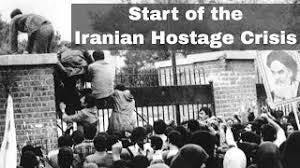
I do not mean only the literal taking of hostages, though that is where the regime began. On November 4, 1979, Islamist students seized the U.S. embassy in Tehran and held American diplomats hostage for 444 days. It was not an accident of revolutionary excess. It became a template.
The practice did not end with the embassy crisis. Over the last two decades, the Islamic Republic has repeatedly detained foreign and dual nationals, using them as leverage in negotiations with Western governments. I should know. I was the longest-held American citizen detained in Iran, and my own release was negotiated in connection with the JCPOA.
I saw the afterlife of that template inside Evin Prison.
In 2009 and 2010, after more than four months in solitary confinement in the IRGC’s high-security ward for political prisoners, I was moved into a group cell with seven or eight prominent reformist politicians. Several were household names in Iranian political circles. Several had also been young militants in 1979, organizers of the U.S. embassy takeover. One had been widely recognized as a leader of that action.
There we were, decades later, sitting in the same prison system the revolution had built, wearing prison clothes, sleeping under rough blankets, waiting on interrogators and guards.
At one point, trying to manage my own mounting fear and anxiety, I joked to one of them that our prison uniforms should come with T-shirts: “The Islamic Revolution: The World’s Greatest Hostage-Takers.”
I thought he might appreciate the irony. One of the men who had helped take American diplomats hostage was now himself a hostage of the same revolutionary state he had helped bring to power.
I was mistaken.
He scowled. He seemed unable even to process the connection. For him, the embassy takeover remained sacred, iconic, wholly justified — one of the founding acts of the revolution. His own imprisonment, by contrast, was illegitimate, a betrayal, an abuse. He could not see that the logic was the same.
That blindness appeared again when I told some of my cellmates what I had concluded after reading all twenty-two volumes of Khomeini’s collected speeches and writings in prison. They insisted that Khomeini had really wanted a democratic Islamic system, and that his original vision had later been distorted into dictatorship. My reading showed me no serious evidence for that comforting picture. Khomeini’s thought was not a democratic promise later betrayed. The authoritarian structure was there from the beginning.
They pushed back hard. I was wrong, they said. I did not understand the nuances. I had missed the history.
But the history is not so mysterious.
This is the Islamic Republic’s genius: it takes hostages at every scale. Individuals, families, political prisoners, women, civil society, neighboring states, maritime chokepoints, and eventually the global economy.
The regime began by taking American diplomats hostage. It never really stopped. Over the last two decades, it has repeatedly detained foreign and dual nationals, turning human beings into bargaining chips with Western governments. I should know: I was the longest-held American citizen detained in Iran, and my own freedom was negotiated in connection with the JCPOA.
Then it took Iranian society hostage: first women, through compulsory hijab and the coercive control of public life; then the population as a whole, through a system that combines theocratic dictatorship with tightly managed, subordinate elections. The real commanding heights — the military, judiciary, security services, communications, oil revenues, and the coercive state — were never seriously up for democratic contestation.
Then the regime exported the method.
In Lebanon, it helped create and sustain Hezbollah, turning a country into a platform for Iranian power. In Iraq after 2003, through Shia militias and later the Popular Mobilization Forces, it embedded itself inside the state while keeping armed leverage outside ordinary sovereignty. In Yemen, through the Houthis, it helped turn a poor and shattered country into a pressure point on the Red Sea and Bab al-Mandab.
And now the same method has reached Hormuz.
This is the Islamic Republic’s genius: it takes hostages at every scale. Individuals, families, political prisoners, women, civil society, neighboring states, maritime chokepoints, and eventually the global economy.
That is why the current U.S.-Iran moment matters so much. If Washington rewards this behavior — if the emerging deal confirms that Iran can threaten Hormuz, activate proxies, absorb punishment, and still extract concessions — then the message will be clear.
Hostage-taking works.
Not because Iran is strong in the normal sense. It is not. Its economy is damaged, its people are alienated, its regime is feared more than loved. But it has mastered a darker form of power: the ability to impose costs on others by making them pay to recover what should never have been seized in the first place.
That is not diplomacy. It is not resistance. It is not strategic sophistication in any honorable sense.
It is hostage-taking as statecraft.
I haven't read all of Khomeini's speech (that must have been some punishment). But some of the research for the novel I am writing, and you are absolutely correct going back to the time of the constitutional revolution.